
The BetaCodex
OpenSpace DEV
How can OpenSpace serve organizational change and transformation – with fifty people, or with hundreds of thousands?
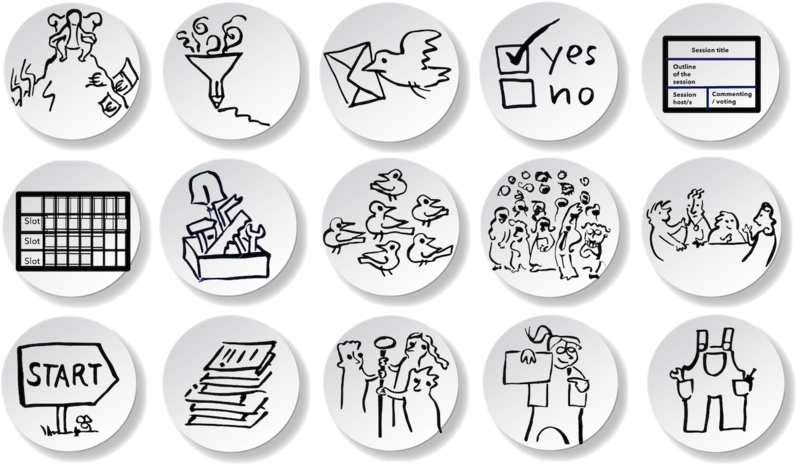
The world’s most powerful large-group method needed retrofitting
OpenSpace for organizational development
OpenSpace Technology, or OpenSpace, can be a powerful enabler of very fast organizational transformation, together with all the willing, all at once. But the commonly practiced forms of OpenSpace are not very well-equipped to be used in the context of organizational change and development work.
Instead, a specific form of OpenSpace is possible and helpful that differs significantly from OpenSpace as you have come to know it. That variant of OpenSpace for organizational change work is called OpenSpace DEV.
OpenSpace DEV was assembled and developed by Silke Hermann and Niels Pflaeging (Red42), starting in 2011, and published in 2025 under the license CC BY-SA 4.0. It can be found at www.redforty2.com/openspacedev (opens in a new tab). It is derived from OpenSpace Technology (opens in a new tab) by Harrison Owen, OpenSpace Agility (opens in a new tab) by Daniel Mezick and OpenSpace Beta – all open source social technologies published under the CC BY-SA license. This page is derived from it.
OpenSpace DEV is an open source social technology
It brings OpenSpace firmly into the realm of organizational development.
Built on OpenSpace
OpenSpace DEV builds upon OpenSpace Technology, invented by Harrison Owen, and incorporates 14 specific characteristics.
From 50 to thousands
It achieves high engagement for change and transformation work, and authorizes groups from 50 people to thousands, or even tens of thousands of people to work the system together.
Do the change work, together
OpenSpace DEV is an important element for Beta transformations, and for contemporary organizational development, done jointly with all the willing.
Get organizational development started together. And done together
OpenSpace DEV is a way to get organizational development work started (or even done), fast.
Two kinds of OpenSpace
OpenSpace Technology and OpenSpace DEV, compared.
OpenSpace Technology (1983)
Suitability
Great for open communities and public conferences.
Reference definition
- Sit in a circle
- Build a bulletin board
- Open a marketplace
- Go to work
Session generation
Starts during the meeting’s opening plenary; involves session pitching.
Intended results
Implicit agreements, unity within the group.
OpenSpace DEV (2025)
Suitability
Great for organizational development, and for use in organizational change and transformation.
Reference definition
- Have a Sponsor
- Theme and invitation by the Sponsor
- Invitees accept or decline; open session generation
- At the meeting, authorization through the Sponsor, who opens and closes the day(s)
- Structure documentation and results on a Prep Day
- Work the system, together
Session generation
Starts weeks before the meeting, online or with physical means for proposing, commenting and voting; continues informally during the meeting.
Intended results
Explicit agreements, structured work streams for organizational development.
The 14 concepts of OpenSpace DEV
-
Authorization to work the system
The Sponsor authorizes participants through their acceptance of the invitation to the OpenSpace.
-
Theme
It is articulated by the Sponsor and written down as a question, with specifications around problem, purpose & means.
-
Invitation by the Sponsor
The Sponsor’s invitation must be a high-quality text. Make it personal, specific and “inviting”.
-
Voluntariness
Invitees must be able to decline the invitation without punishment.
-
Session generation
Start session generation, voting and commenting weeks in advance – online or in a physical space.
-
Session grid
Start the OpenSpace day(s) with a grid that’s 70% to 80% filled.
-
Meeting duration
A duration of a single day or slightly less is sufficient – if other OpenSpace DEV parameters are met.
-
Single-space and flat
Make the meeting single-space and flat: it will increase the fluidity and intensity of the experience many times over.
-
Role of the Sponsor
She or he opens and closes both the meeting day and the Prep Day, and takes part in sessions like anybody else.
-
Session design
Make circles small enough to provide intimacy, and sessions long enough for depth of conversation.
-
Plenary setting
Focus the introduction on principles, refrain from storytelling and metaphors. Keep the closing plenary tight.
-
Session documentation
It is indispensable, critical input for the Prep Day. Use physical means for consistent documentation.
-
Informal gathering
End the OpenSpace meeting with an informal gathering for social processing.
-
Prep Day
Follow up the OpenSpace with an invitation-based session to cluster and sort content, and to identify and assign work streams.
Not a menu, but a set of requirements for OpenSpace serving organizational change.
Unity arises from joint action – it cannot be produced in advance. Much insight comes from learning in action.
Silke Hermann & Niels Pflaeging, creators of OpenSpace DEV
Where it comes from
1983
Harrison Owen invents OpenSpace Technology.
2011
Silke Hermann and Niels Pflaeging begin to adapt OpenSpace for client groups of 100 to 300 people – with session proposals submitted online by participants, weeks before the meeting.
2018
Silke and Niels apply OpenSpace DEV systematically as part of OpenSpace Beta transformation processes.
2025
Research paper No. 25 describes OpenSpace DEV. The research is dedicated to the memory of Harrison Owen (1935–2024).
Hear more about OpenSpace DEV
Niels Pflaeging in conversation with Rijon Erickson about OpenSpace DEV, recorded live in July 2025.
OpenSpace DEV as a research paper
Free of charge and free of registration. Share it and use it in your work – making the appropriate attributions.
Download the research paper
Printed OpenSpace posters are available through the Red42 shop (opens in a new tab).
Want to go deeper?
Sources on OpenSpace DEV, chosen by the network.