The BetaCodex
The laws of the BetaCodex
In order to address complexity, organizations do not need one monolithic tool or theory: They do not need a framework.
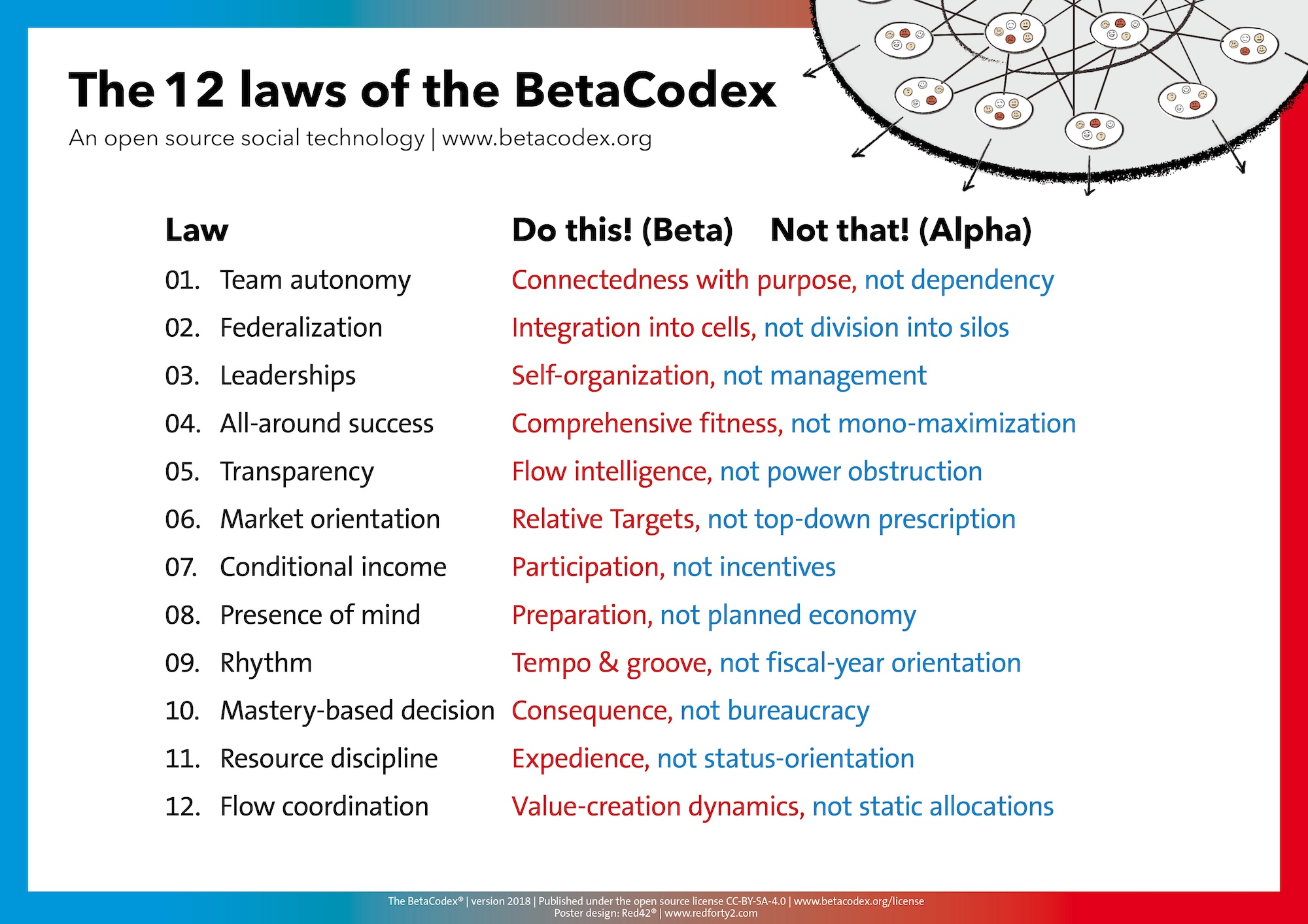
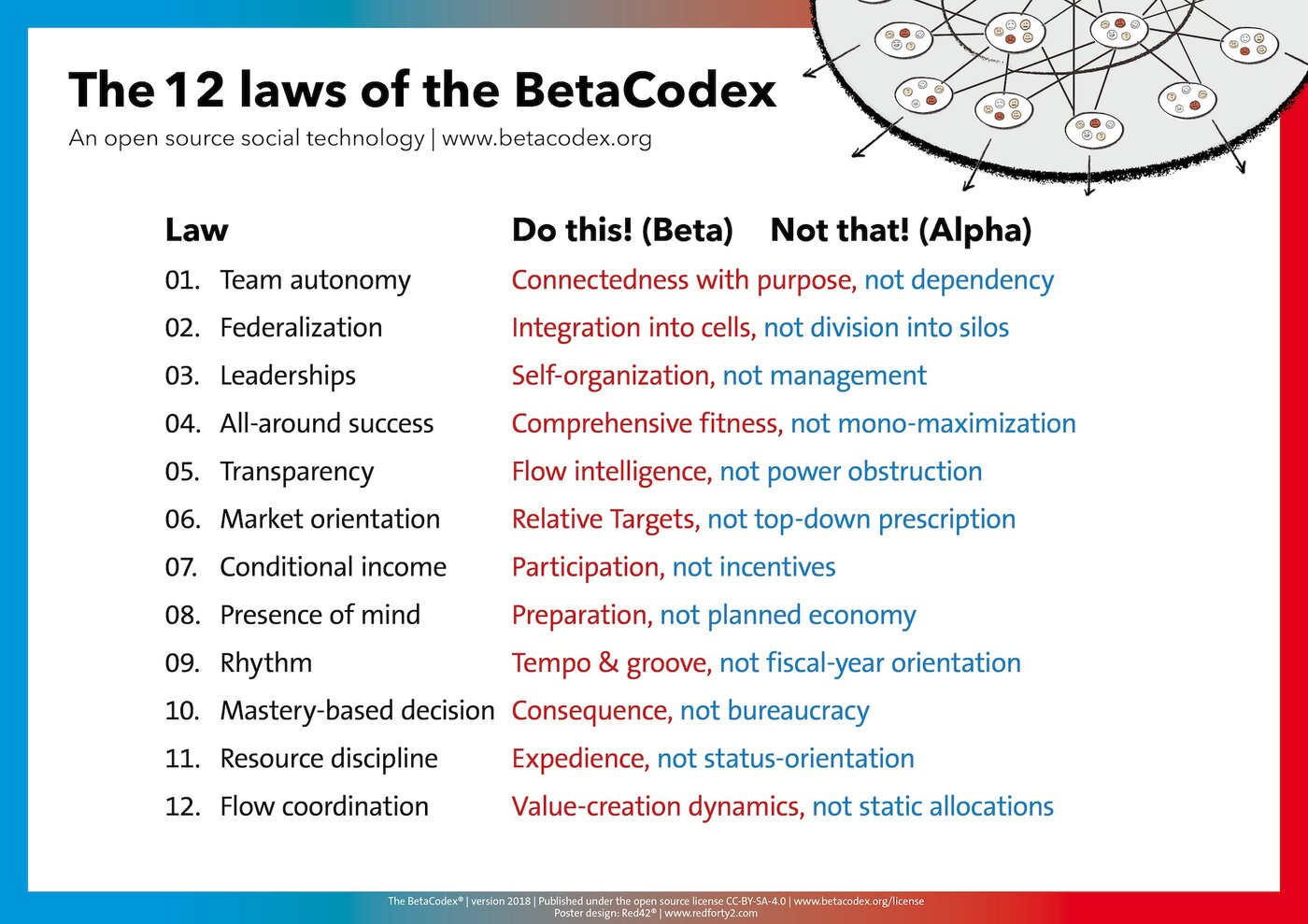
The 12 laws of the codex
Everything you need for coherent self-organization, decentralization and organizational democracy.
-
Team autonomy
Connectedness with purpose, not dependency
-
Federalization
Integration into cells, not division into silos
-
Leaderships
Self-organization, not management
-
All-around success
Comprehensive fitness, not mono-maximization
-
Transparency
Flow intelligence, not power obstruction
-
Market orientation
Relative Targets, not top-down prescription
-
Conditional income
Participation, not incentives
-
Presence of mind
Preparation, not planned economy
-
Rhythm
Tempo & groove, not fiscal-year orientation
-
Mastery-based decision
Consequence, not bureaucracy
-
Resource discipline
Expedience, not status-orientation
-
Flow coordination
Value-creation dynamics, not static allocations
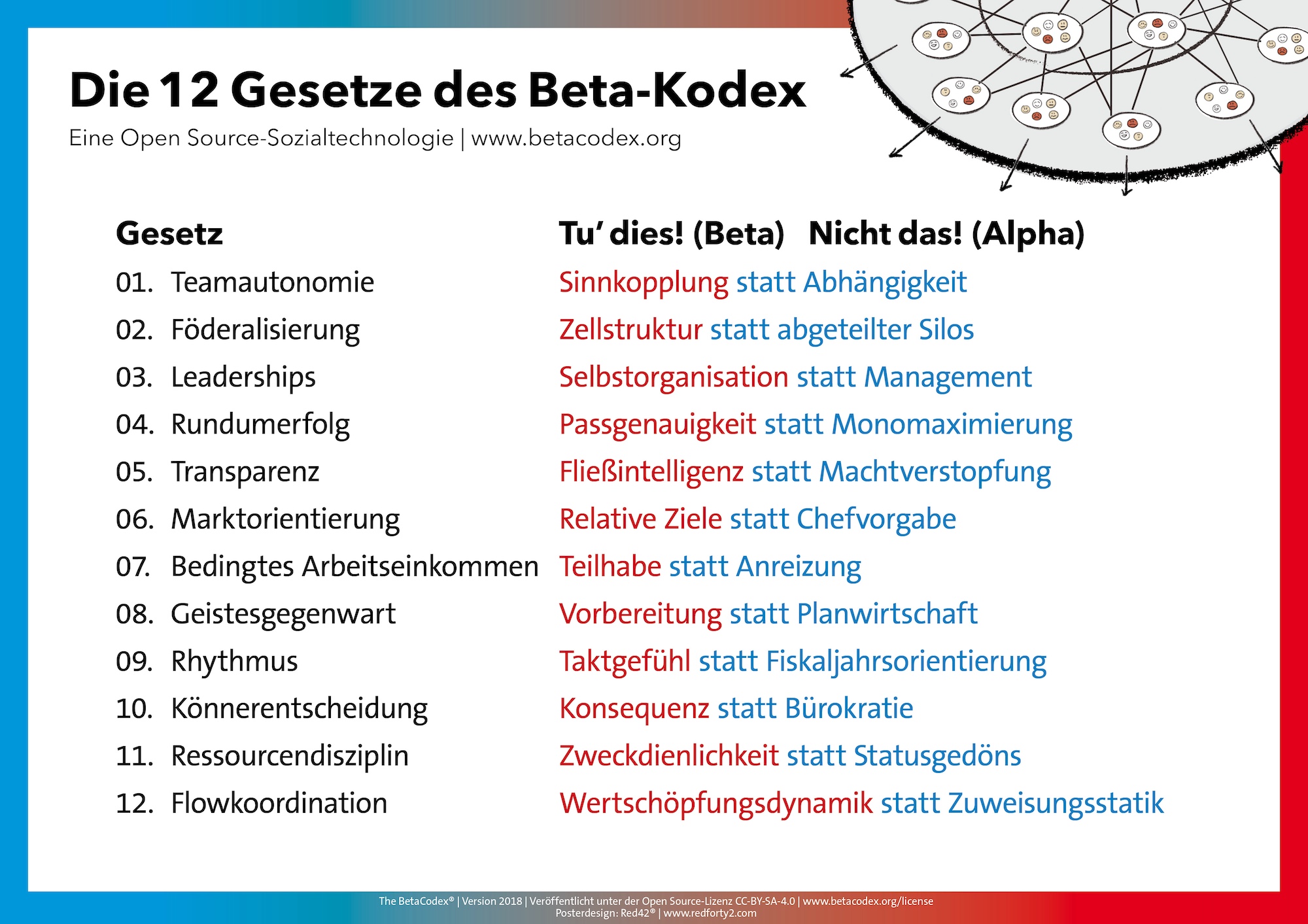
The 12 laws as a poster
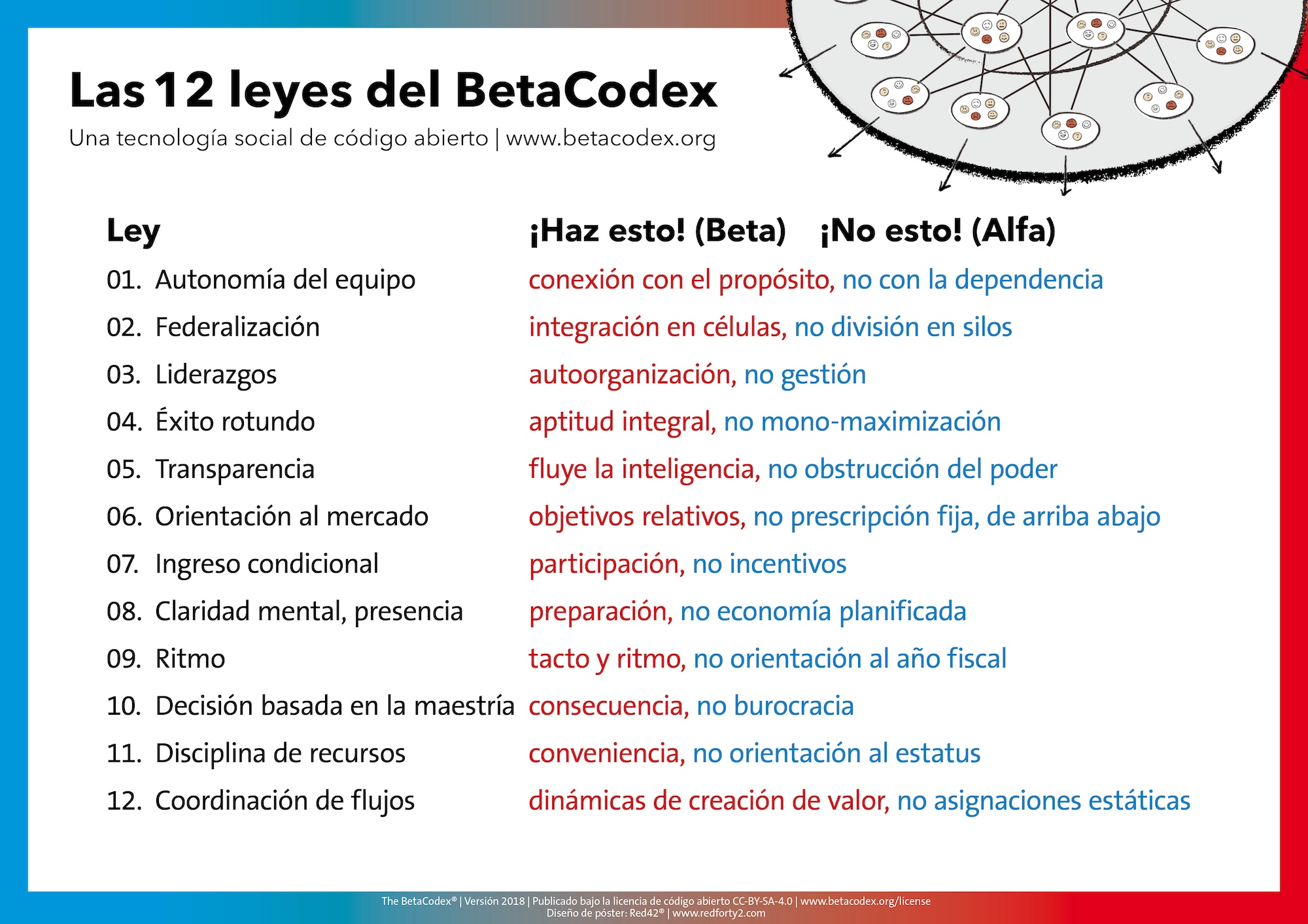
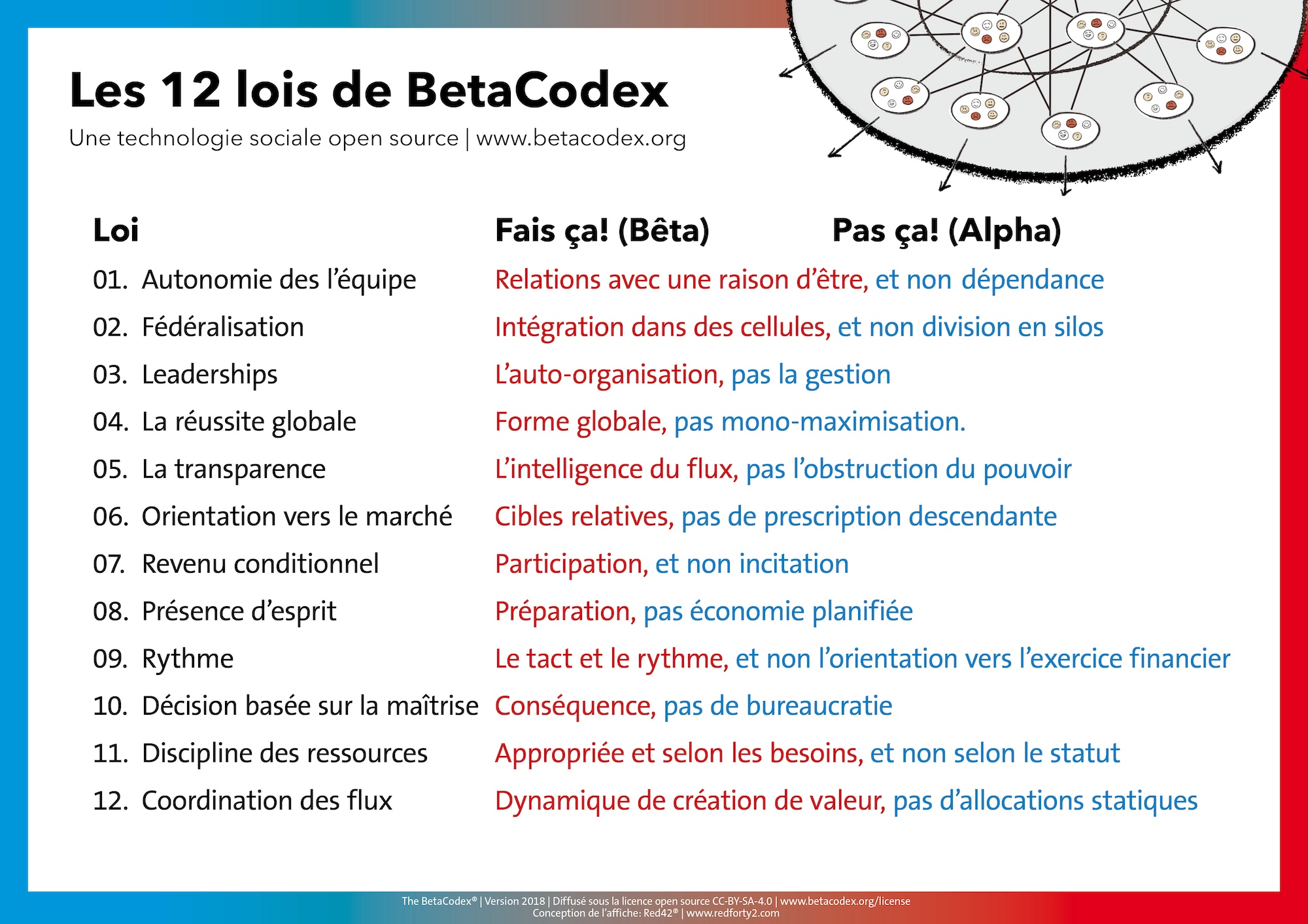
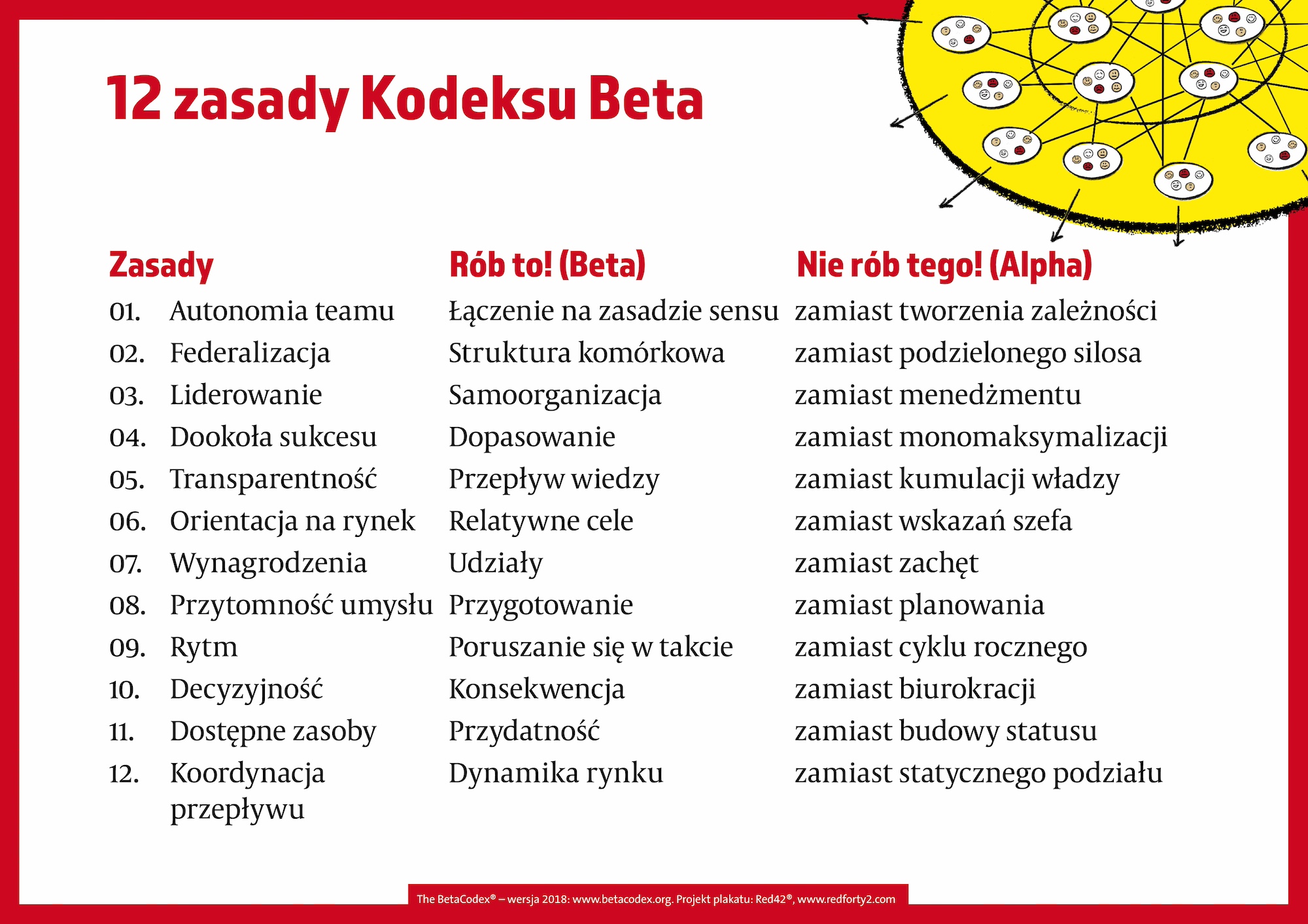
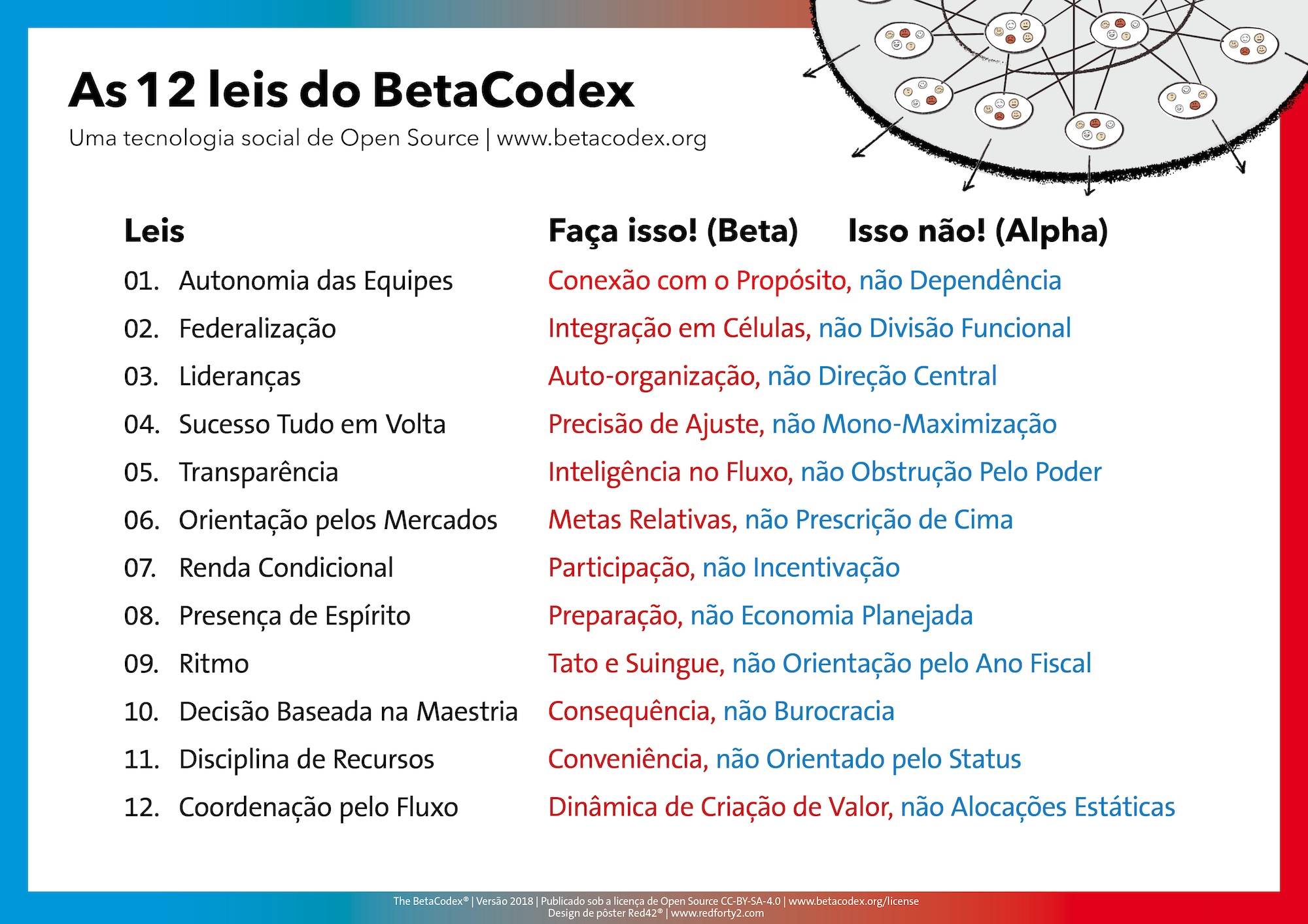
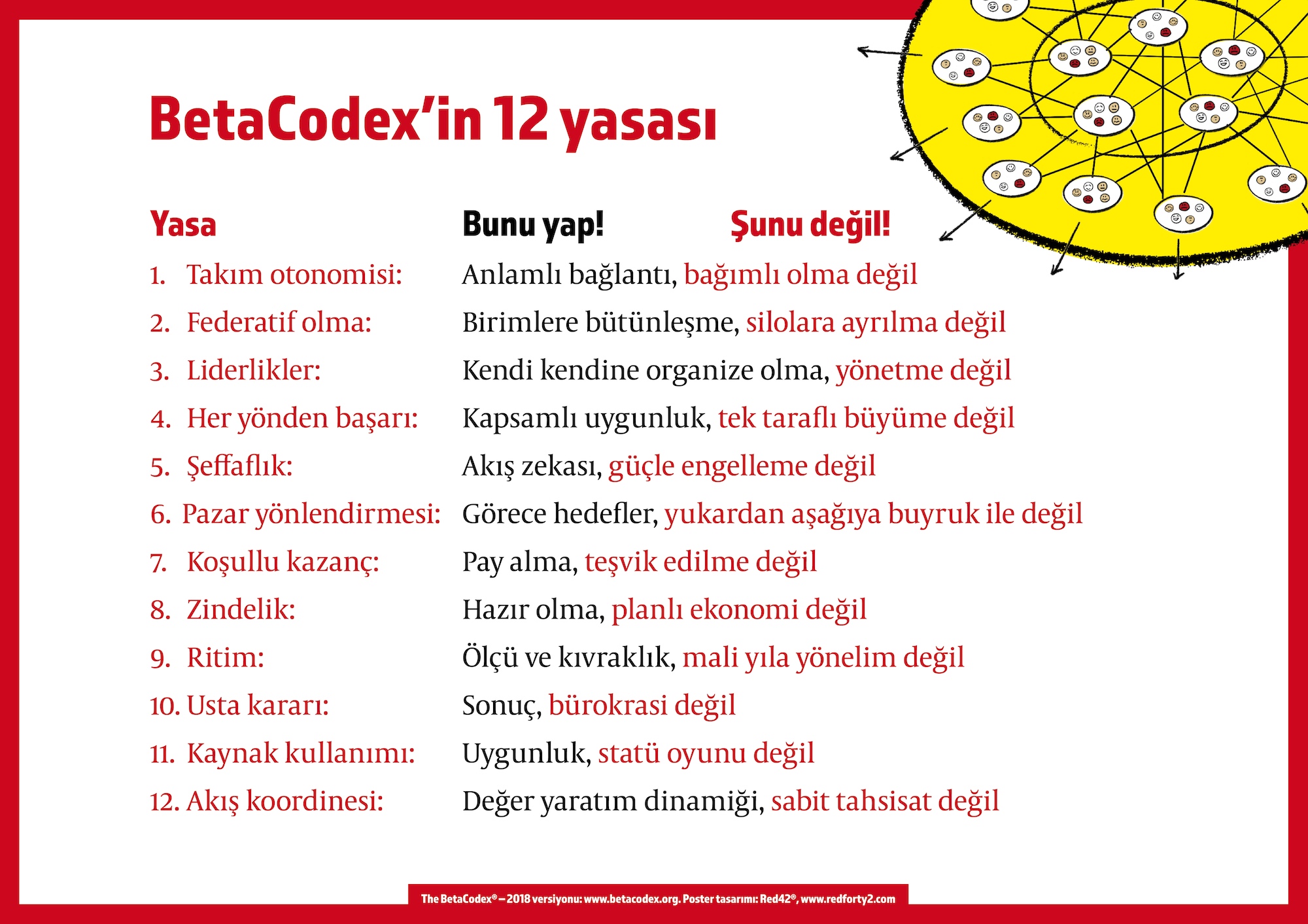
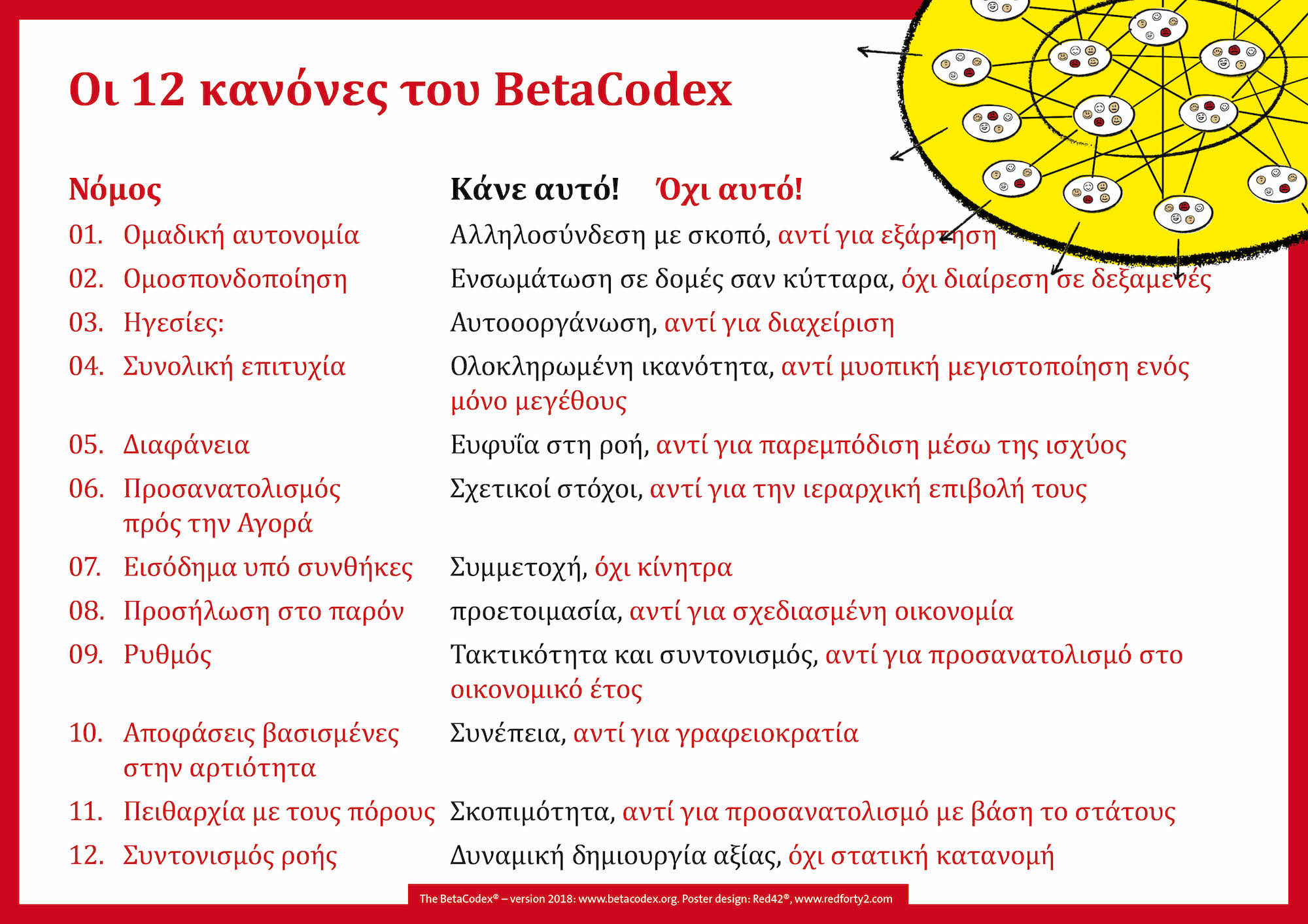
In eight languages, to print, share and put on the wall.
Download the poster
- EnglishWeb JPG · 571.8 KBPrint JPG · 5.2 MB
- DeutschWeb JPG · 597.8 KBPrint JPG · 5.3 MB
- EspañolWeb JPG · 605.1 KBPrint PDF · 548.6 KB
- FrançaisWeb JPG · 631.0 KBPrint PDF · 533.0 KB
- PolskiWeb JPG · 618.5 KBPrint JPG · 1.8 MB
- PortuguêsWeb JPG · 603.5 KBPrint PDF · 510.4 KB
- TürkçeWeb JPEG · 649.9 KB
- ΕλληνικάWeb JPG · 366.8 KB
Principles and rules: They are not the same
In order to address complexity, organizations do not need one monolithic tool or theory: They do not need a framework. Instead, they need coherent, shared language and imagery, and a “system of systems” concept that everyone in the organization can acquire and integrate through learning.
Consequently, it is crucial to Beta that it is not based on rules, but on principles. Unlike other organizational concepts, the BetaCodex is neither a prescription nor a hammer, nor is it a one-size-fits-all solution. It is a system of systems concept, a way of thinking and acting, a way of being.
Rules
The difference between rules and principles is that for setting up rules, you need to analyze every possible situation before formulating it. Rules are based on the pattern of if-this-happens-do-that. Whenever a previously unknown or unthinkable situation occurs, however, rules fail. That is like landing on the Hudson River.
Rules simply do not support you in finding good solutions to never-before-thought-of problems. Surprising problems, however, now occur regularly in our everyday work lives and in our businesses.
Principles
Principles, by contrast, do not just apply to known problems. You do not need to be aware of all possible situations. You apply them within whatever situation as it occurs. Principles are like guidelines that help you test whether your actions are aligned with your beliefs and values, or not. If not, you have to search for another way to solve the problem.
Understanding this difference, you are able to adopt BetaCodex principles (or “laws”) to your firm or to situations you encounter at your work – anywhere, at all times.
Still, we have recognized that it takes practice to understand the full impact of the BetaCodex, as compared with tayloristic organization. This is because the model is based on a set of 12 cohering and interdependent principles (see above). Only when applying the full set of principles will your organization be rewarded with the superior results the codex offers.
Not a salad bar to choose from.
Coherence matters!
The 12 laws of the codex articulate a coherent new organizational model that is opposed to the command-and-control management model which thought leaders like Frederick Taylor, French engineer Henri Fayol, automotive executives Alfred Sloan and Henry Ford developed about 100 years ago.
The principles of Beta are not a salad bar to choose from: You do not get to pick the principles you are most comfortable with! Only by applying the full set of the 12 principles are organizations rewarded with the superior performance the model has to offer.
Lennart Francke, former CFO of Handelsbanken, was often asked if the Handelsbanken model, today known as the Beyond Budgeting model, could be applied partly, in bits and pieces, and he replied:
Imagine Great Britain would change from left-side traffic flow to right-side traffic as practiced on the European continent. And imagine that the British people might say: ‘Okay, but to us, the British, that appears way too radical and too complex to be done in a rush. Let’s therefore start next week with the buses and the trucks only.’ It is just the same with Beyond Budgeting.
Lennart Francke, former CFO of Handelsbanken
Decentralization and relative performance contracts.
Where the 12 laws come from
Since 1998, the Beyond Budgeting Round Table (BBRT) and then its spiritual successor, the BetaCodex Network, have drawn upon case study-based research to conclude that companies with a contemporary view of human nature don’t control them with plans and fixed targets, but rather they aim for “relative” performance contracts with them instead. Early on, the BBRT concluded that there had to be a set of 12 central principles of the organization model based on “relative performance contracts,” contrasted against the assumptions of fixed performance contracts.
Decentralization and relative internal agreements are based on the assumption that it is unwise to set fixed targets for managers and teams and then try and control their behavior and activities in terms of these targets. The implicit agreement is that it is the task of managers to provide an inviting, stretching and open work climate within which employees agree to aim for continuous performance improvements. Managers and employees collectively use their knowledge and their own common sense to adapt to changing conditions and environments.
With decentralization and relative internal agreements, decisions are not made at the top. Instead, they are distributed, decentralized, and devolved as far out as possible. This type of performance contract is based on mutual trust. Increased transparency and higher expectations towards teams (compared to competitors or their equivalent), provide a permanent challenge. Responsibility for performance and decision-making are gradually moved away from individuals in the center of the organization towards teams in the periphery.
The BetaCodex: a paradigm, a philosophy, a mental discipline
The BetaCodex suggests another way of looking at performance, success, and an organization’s raison d´être. Ask yourself: “Why does your organization not deliver the performance you might expect?” Or: “Why does performance not improve?” Or: “Why do people in your organization seem de-motivated?” Well, then, the BetaCodex suggests, you should ask for the causes not by assigning blame, but by identifying the systemic problems in the organization itself.
- of all problems within organizations are caused by the system
- 96%
- by humans within the system
- 4%
Systems theorist W. Edwards Deming liked to emphasize that about 96% of all problems within organizations are caused by the system, and only 4% by humans within the system. He had a point.
To describe the new breed of post-taylorist 21st century organization, which we call BetaCodex organizations, these tags fit well:
decentralized, federative, “devolved” · democratic, civic · ethical, humanist, enlightened · adaptive, agile, teal · people-oriented · empowering · entrepreneurial · high-performance · functionally integrated · self-organizing, self-organized · holistic, systemic · no-planning, no-leader · power-with · non-authoritarian, non-paternalistic · lean · open book · market-driven · complexity-robust · fractal · sense-and-respond, pull · human-centric · un-bureaucratic · interdependent, interwoven, networked · new/next/beyond management · post-taylorist · follettian · sustainable · stakeholder-oriented
From Beyond Budgeting to the BetaCodex
- 1998Beyond Budgeting research begins
- 2007End of the Beyond Budgeting research period
- 2008Founding of the BetaCodex Network
Scroll sideways for more years
The BetaCodex is a “mind set” that results in putting an end to taylorism and hierarchical command-and-control. Through decentralization, it allows to shift entire organizations to total market-pull. In this sense, the organization can become “managed,” or steered by market-pull, instead of relying on internal steering. Traditional “management” and “governance” become obsolete. If they continue to exist, they are counterproductive, lead to waste and can even harm the organization.
The origin of this thinking lies in several concepts and movements, such as Socio-Technical Systems research conducted by the Tavistock Institute, and especially in the so-called Beyond Budgeting model. The Beyond Budgeting research between 1998 to 2007 taught us, however, that concept brands such as “Beyond Budgeting” almost inevitably lead to some confusion. We saw countless academics and “experts” fall prey to the idea that a concept by that name just had to be somehow related to “planning,” or financial management. In truth, the term Beyond Budgeting merely hinted at the starting-point that the movement's research had departed from: But many other starting points would have been possible.
The transformation proposed by the Beyond Budgeting model and movement could have been appropriately described through the Peter Drucker phrase that “90% of what we call management are actually practices that keep back people from doing their work.” The challenge is to abolish those 90% of management practices and get the 10% of actual leadership practices right. Although “Beyond Budgeting” was never conceived as a controlling or financial concept, even publications from acknowledged management experts proved that the term Beyond Budgeting was all too often misunderstood. Sadly, even the Beyond Budgeting movement's directors have fallen prey to oversimplifying Beyond Budgeting as a “finance” or “performance management” thing. To break free from such misunderstandings and misinterpretations for good, we renamed and re-articulated the approach we stand for as “the BetaCodex,” in 2008.
90% of what we call management are actually practices that keep back people from doing their work.
Peter Drucker
The two foundations of the BetaCodex
The rise of the new organizational model that we call the BetaCodex is driven by today’s ever-changing world. No less. Today’s dynamics and uncertainty defy industrial-age wisdom of “management” and organizational design. The 100-years old notions of managing do not support today’s critical success factors which are more varied than in the industrial age. The command-and-control management model is insufficient for the 21st century precisely because of that.
The BetaCodex itself is supported by two pillars.
Science
First, by scientific thought leadership from fields as varied as sociology, complexity theory, psychology and the business sciences.
Practice
Second, by practice – through pioneering organizations of varying history, size, cultural background, and from vastly different industries.
The case for change is so compelling today, because theory from different sciences, and practice from pioneering organizations which are leaders in their respective fields has been brought together. Combined into a set of robust organizational theories that are integrated into the BetaCodex.
Want to go deeper?
Sources on the laws of the BetaCodex, chosen by the network.