
The BetaCodex
Time-Oriented Software Development
What if time, not capacity, were the boss in software development? TOSD brings flow and the structure of time to agile software development – beyond Scrum, Kanban and Lean.
Time is the ultimate structure. Not positions, not meetings, not frameworks
The newest BetaCodex social technology
Time-Oriented Software Development, or TOSD, is the newest of the BetaCodex social technologies. It joins Cell Structure Design, Relative Targets, OpenSpace Beta and OpenSpace DEV – and brings Beta to the way software gets built. TOSD was articulated and published as an open source social technology in 2025 by Niels Pflaeging and Sebastian Kubsch, under the license CC BY-SA 4.0, and can be found at www.redforty2.com/tosd (opens in a new tab). This page is derived from it.
Two decades of Agile have changed the vocabulary of software development, but rarely its organization. Sprints, backlogs, story points and scaling frameworks have all too often been absorbed by command-and-control. TOSD takes a different route. It does not add roles or ceremonies. It uses time itself as the structure that creates focus, discipline and flow.
The core idea is simple, and it turns conventional thinking upside down: delivery time is fixed, and capacity swings. Not the other way round.
TOSD is an open source social technology
Simple to start. Hard to unsee.
Time is fixed, capacity swings
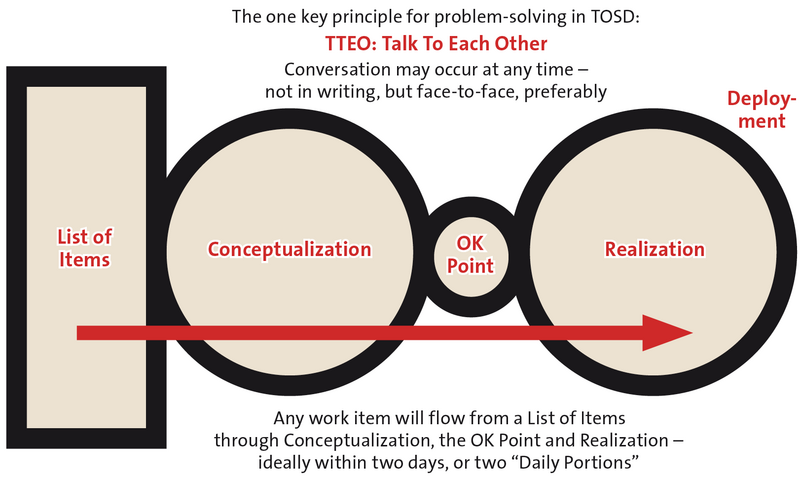
Every item is realized in one, two or three days, then deployed. Instead of estimating work, teams shape it until it fits the time.
No special training
TOSD needs agreement on a few principles and a simple process. Not certifications, not coaches, not a new layer of roles.
Scales without frameworks
From a single team to hundreds of people working from several lists – combined with Cell Structure Design and Relative Targets.
Live within a few weeks. Months, quarters or years
Adoption of a time-oriented system takes just a few weeks. You can start at any time, with any software team.
It’s better to design punctuality than to manage delays."
Ernst Weichselbaum (1944–2024)
Where TOSD comes from
Roots
Austrian consultant Ernst Weichselbaum (opens in a new tab), pioneer of flow-based work systems, reinvents Time Orientation, time-boxed work and Daily Rhythm. He creates concepts like the OK Point – and what can be achieved with time orientation in manufacturing.
2025
Sebastian Kubsch and Niels Pflaeging bring time orientation to software development, at German software firm Pradtke. Achieving the switch to the TOSD system takes four weeks.
1st paper
In Autumn of the same year, TOSD is shared with the world through an open source license. The “Introducing Time-Oriented Software Development” research paper (BetaCodex paper No. 26) is published in English, German and Spanish.
2nd paper
“Patterns of Time-Oriented Software Development” (research paper No. 27) is published. The paper outlines 18 patterns derived from TOSD practice, with some patterns related to AI-aided software development, specifically.
The item must be so precise that you don't have to guess. You must be able to know it will take a single day to do the Realization – give or take. No estimation necessary."
Sebastian Kubsch, co-creator of TOSD
The 7 laws of TOSD
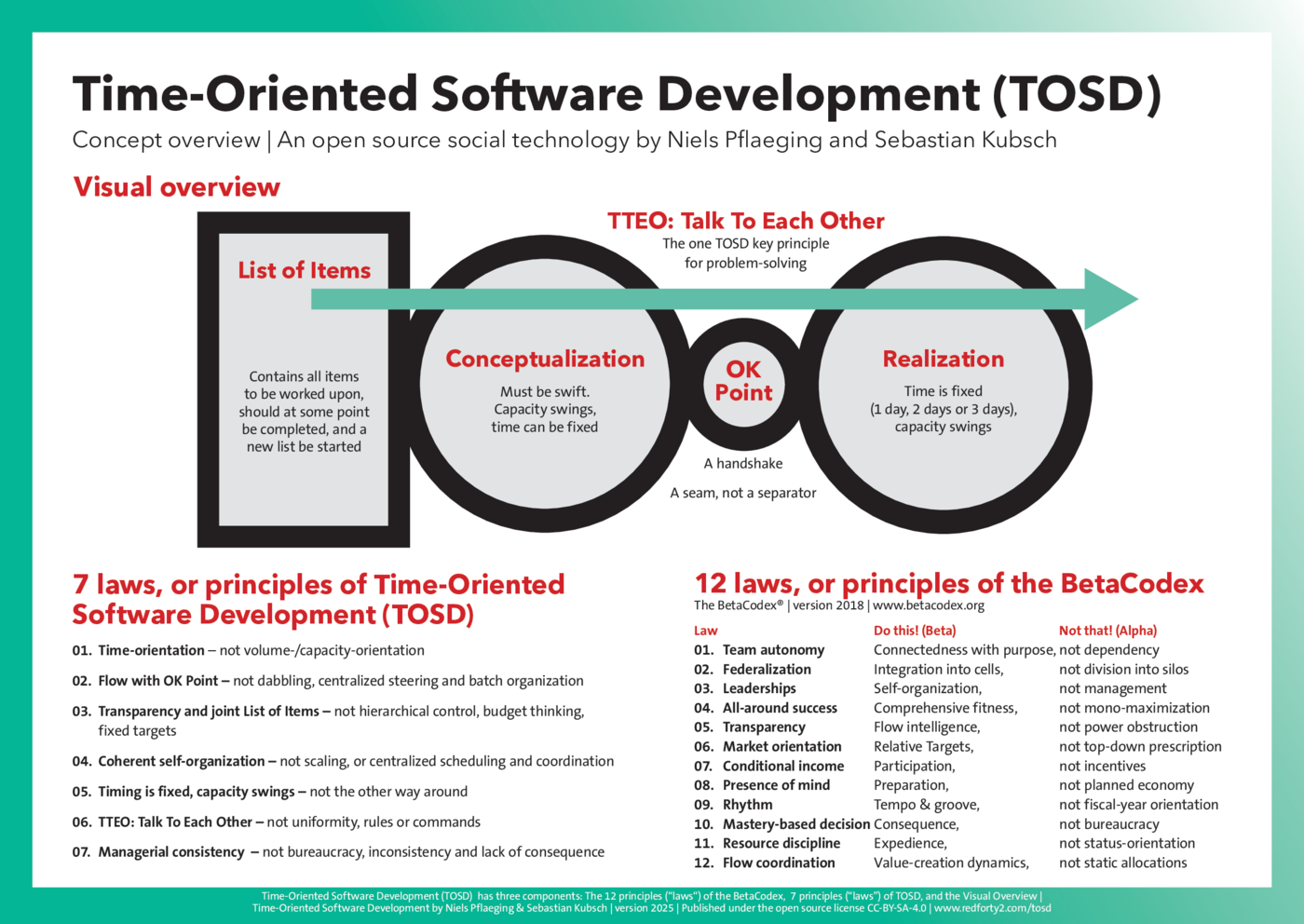
TOSD has three components: the 12 principles of the BetaCodex, the 7 principles of TOSD, and the Visual Overview.
-
Time-orientationnot volume-/capacity-orientation
-
Flow with OK Pointnot dabbling, centralized steering and batch organization
-
Transparency and joint List of Itemsnot hierarchical control, budget thinking, fixed targets
-
Coherent self-organizationnot scaling, or centralized scheduling and coordination
-
Timing is fixed, capacity swingsnot the other way around
-
TTEO: Talk To Each Othernot uniformity, rules or commands
-
Managerial consistencynot bureaucracy, inconsistency and lack of consequence
TOSD does not need this stuff
Much of what Agile has piled up over the years simply falls away.
Agile Coach role · Agile measures/metrics · Agile maturity models, people categorizations, readiness measures · Approvals · Architects (title) · Backlogs · Business Analysts · Capacity measures · Committees · Dailies, Stand-ups · Deadlines · Development teams/Scalable teams · Estimates · Fixed targets · Flow metrics · Funding of projects/Resource pools · Handovers · Individual targets · Issue Tracking Software · Iterations/MVP · Kanban boards · OKRs · Phases · Planning · Portfolio planning · Prioritization · Product Manager/management · Product Owner role · Product roadmap · Product strategy · Production Readiness reviews · Project Manager role · Requirements · Retrospectives · Lead/Scrum Master roles · Scaling frameworks/coordination · Scheduling · Sprints/Cadences · Sprint goals · Sprint planning · Story points · Strategy/Governance (as something remote from the TOSD system) · Subject Matter Experts role · Testers (title) · Tickets, ticketing systems · User stories · Utilization measures · UX Designers (title/position)
At least one List of Items. Nominated Conceptualizers, Realizers and List Owners. An OK Point with handshakes every morning. Items sized to single days. People who Talk to Each Other. Removing barriers to flow and practicing Daily Rhythm. That's the basic setup of a TOSD System.
TOSD as a poster
The concept on one page, to print, share and put on the wall.
Download the poster
- EnglishPrint PDF · 295.8 KB
- EspañolPrint PDF · 303.9 KB
Services, qualifications and the TOSD Team around Sebastian Kubsch can be found on www.timeoriented.dev (opens in a new tab). Print editions of the research papers are available in the Red42 shop (opens in a new tab).
Want to go deeper?
Sources on Time-Oriented Software Development, chosen by the network.
-
 Research paperIntroducing Time-Oriented Software Development
-
 Research paperPatterns of Time-Oriented Software Development
-
 News from the Beta WorldTime-Oriented Software Development: The new kid on the agile block
(opens in a new tab)
-
 News from the Beta WorldTime-struck: An entrepreneur‘s view of time-orientation in software development
(opens in a new tab)