The BetaCodex
Cell Structure Design
What does a Beta organization look like, in practice? What kind of structure does a decentralized organization have? How do decision-making, power and authority work, in decentralization? Cell Structure Design gives clear answers to these questions.
Two cornerstones. One of them is Cell Structure Design.
The practical expression of Beta
Two BetaCodex-based “social technologies” are key to all Beta organizations. One might say that this two-fold socio-tech is the practical expression of Beta in organizational reality. One of these social technologies is Cell Structure Design, the other is Relative Targets. We talk about Relative Targets on a separate page on this website.
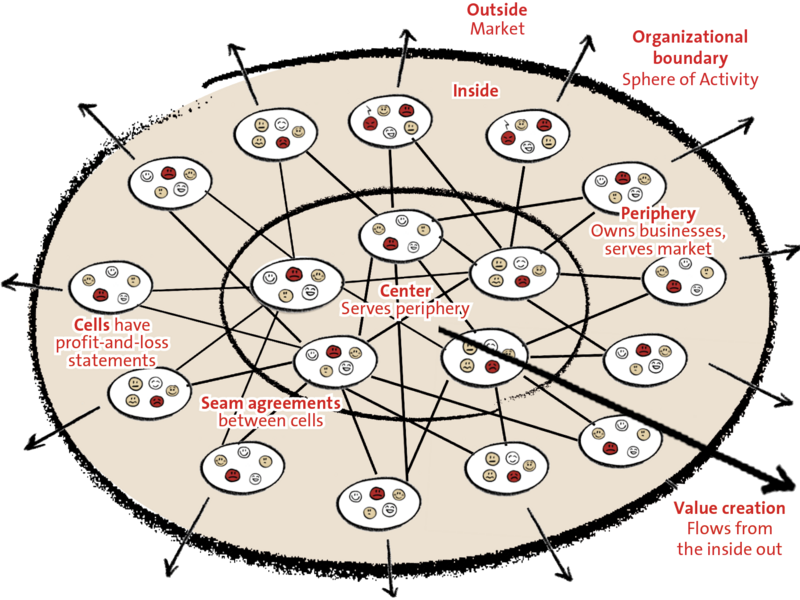
Cell Structure Design conceptualizes decentralized organizational design, leaderships and consistent self-organization, in all its facets. Never have the concepts of organizational decentralization and functional integration been outlined quite as succinctly. Cell Structure Design was articulated and published in 2019 by Silke Hermann and Niels Pflaeging (Red42), under the license CC BY-SA 4.0, and can be found at www.redforty2.com/cellstructuredesign (opens in a new tab). This page is derived from it. And while it is rather “new” as a concept, it has a long history and tradition, and it has been practiced in dozens of organizations from all kinds of industries.
Cell Structure Design is an open source social technology
Built around value creation
Cell Structure Design is the world's leading approach for building an organization around value creation - instead of building it around functions, departments, processes or "leaders".
Decentralized and self-organized
It is the only organization design approach that's capable of bringing about a consistently decentralized and self-organized structure - with highly autonomous, market-oriented teams in an organization's Periphery and Center.
For any organization
Cell Structure Design is applicable in any organization - regardless of its background, size, history, industry, origin or geographic distribution. Get started with Cell Structure Design at any point in time.
Live within weeks. Not months or years.
Done right, the new, decentralized cell structure capable of performing way better than your previous "siloed and departmental" structure can go live within weeks. Not months or years.
Principles and recommendations
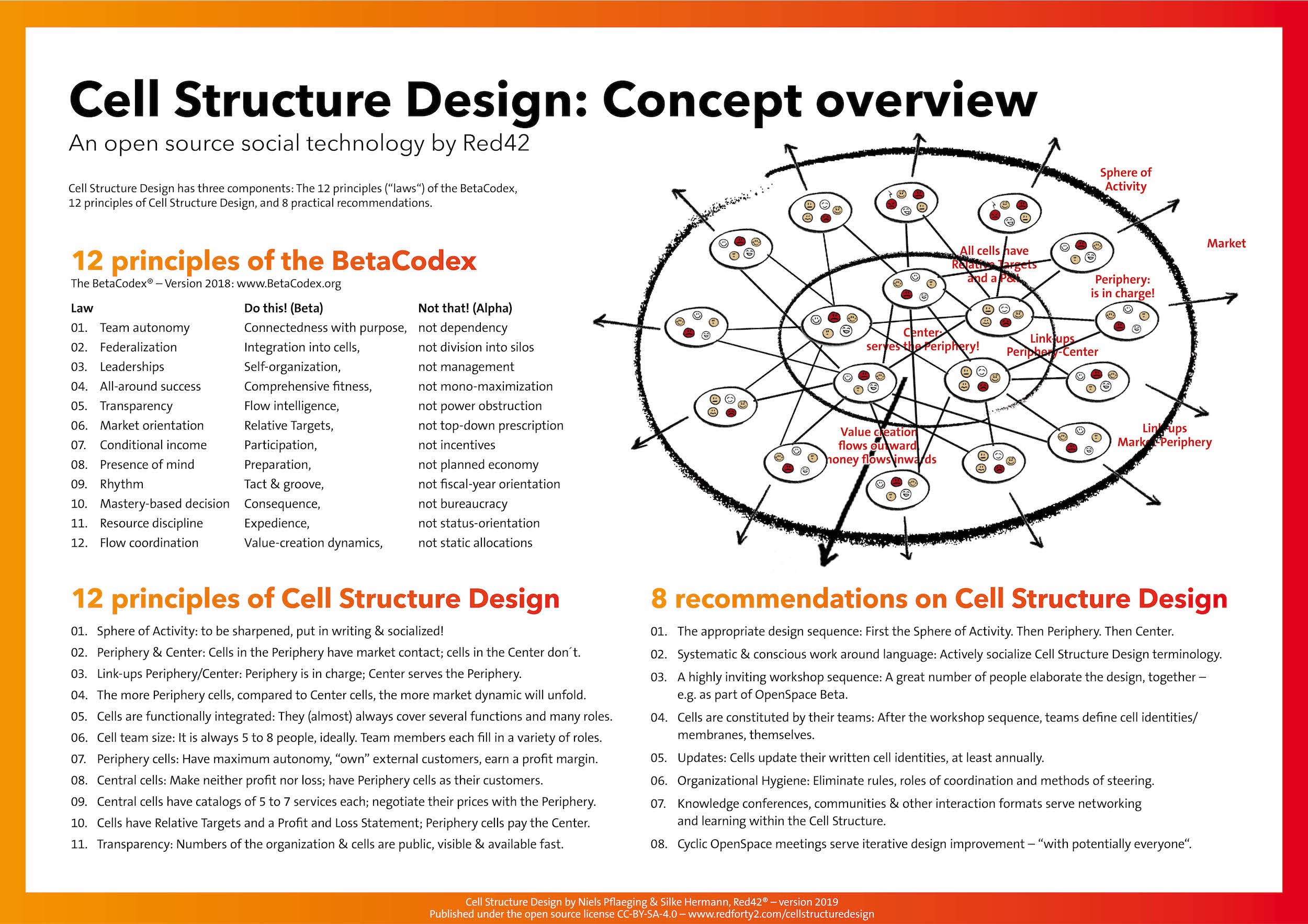
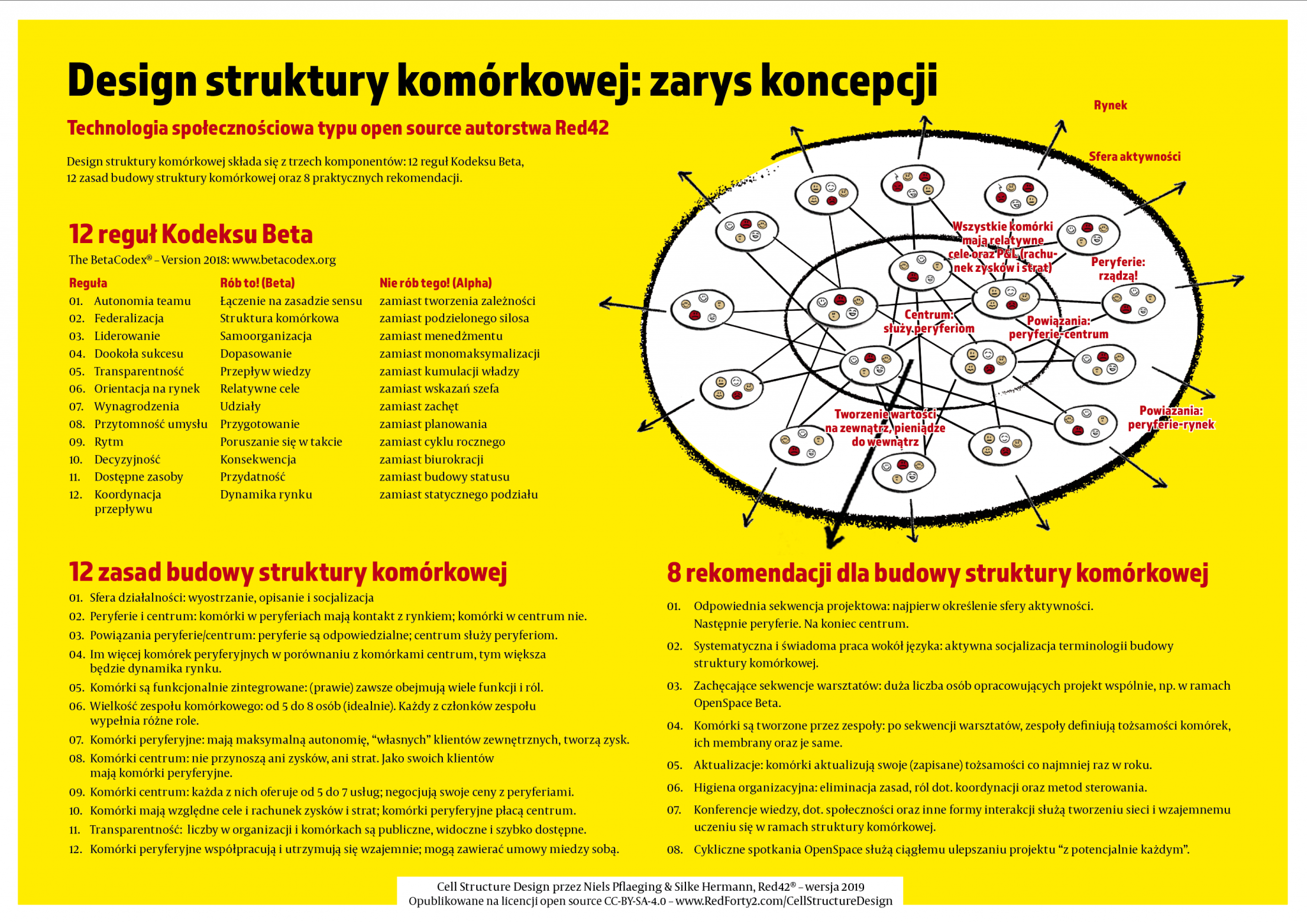
Cell Structure Design has three components: The 12 principles (“laws”) of the BetaCodex, 12 principles of Cell Structure Design, and 8 practical recommendations.
12 principles
- Sphere of Activity: to be sharpened, put in writing & communitized!
- Periphery & Center: Cells in the Periphery have market contact; cells in the Center don't.
- Link-ups Periphery/Center: Periphery is in charge; Center serves the Periphery.
- The more Periphery cells, compared to Center cells, the more market dynamic will unfold.
- Cells are functionally integrated: They (almost) always cover several functions and many roles.
- Cell team size: It is always 5 to 8 people, ideally. Team members each fill in a variety of roles.
- Periphery cells: Have maximum autonomy, “own” external customers, earn a profit margin.
- Central cells: Make neither profit nor loss; have Periphery cells as their customers.
- Central cells have catalogs of 5 to 7 services each; negotiate their prices with the Periphery.
- Cells have Relative Targets and a Profit and Loss Statement; Periphery cells pay the Center.
- Transparency: Numbers of the organization & cells are public, visible & available fast.
- Periphery cells cooperate and help each other, can make agreements with each other.
8 recommendations
- The appropriate design sequence: First the Sphere of Activity. Then the Periphery. Then the Center.
- Systematic & conscious work around language: Actively communitize Cell Structure Design terminology.
- A highly inviting workshop sequence: A great number of people should elaborate the design, together – e.g. as part of an OpenSpace Beta chapter.
- Cell constitution: Cells are then constituted by their respective teams. After the workshop sequence, teams define cell identities/membranes, themselves.
- Updates: Cells update their written cell identities, at least annually.
- Organizational Hygiene: Eliminate rules, roles of coordination and methods of steering.
- Interaction formats: Knowledge conferences, communities & other formats serve the purpose of networking, agreement-building and learning within the Cell Structure.
- Cyclic OpenSpace meetings serve iterative design improvement – “with potentially everyone”.
It is probable that one day we shall begin to draw organization charts as a series of linked groups rather than as a hierarchical structure of individual 'reporting' relationships.
Douglas McGregor (1906–1964)
Cell Structure Design as a poster
The concept on one page, to print, share and put on the wall.
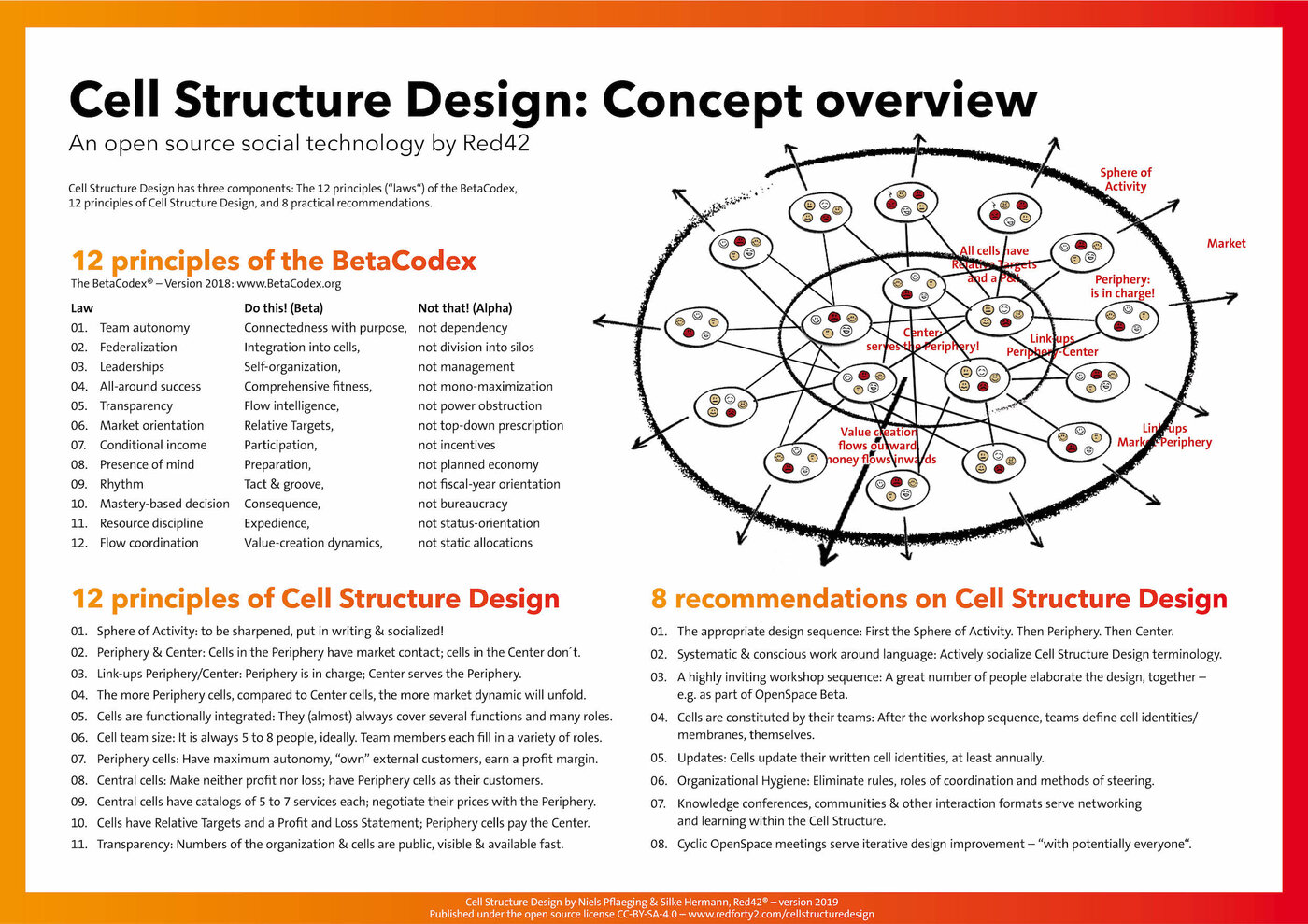
Download the poster
- EnglishWeb JPG · 553.7 KBPrint JPG · 8.9 MB
- DeutschPrint JPG · 9.3 MB
- EspañolPrint PDF · 532.4 KB
- FrançaisPrint PDF · 531.1 KB
- PolskiWeb PNG · 2.3 MB
- PortuguêsPrint PDF · 531.8 KB
Watch an introduction to Cell Structure Design
You can buy Cell Structure Design-related products, and use the learning resources on the www.cellstructuredesign.com (opens in a new tab) web page.
Want to go deeper?
Sources on Cell Structure Design, chosen by the network.