
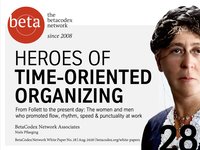
In this study, we offer a fresh look at management history, industrial progress and the history of the productivity movements of the last five decades. We also look at what time-oriented organizing could be capable of, in the future. Our hypo-thesis is that, since the dawn of the industrial age, organizational characteristics like effectiveness, effici-ency and productivity, leanness and agility have been misinterpreted, by and large – except by a minority of pioneers, thinkers and practitioners, whose work we honor in this paper.
We argue that matters of high performance, at their core, were always about time and the proper use of time in organizing. Not cost or quality (which are effects). Not automation (which is a by-product of technological advancement). Not about people and how to improve them. Not about speed per sé. We argue that rhythm, flow and punctuali-ty are key ingredients to creating high performance, and that time orientation is the foun-dation of decentralization and consistent self-organization (which are at the heart of the BetaCodex). In the last five decades, we have usually over-accentuated tools and fads, effects and technology. Still, the quest for time orientation prevailed, as this research aims to show. We put the resulting insights to your consideration.
Most of the photos in this paper – including that of Mary Parker Follett on the cover – have been transformed from black-and-white into color for the first time. In fact, some of the heroes we pay homage to have probably never been depicted in fully colored photos before – which is quite certainly the case of the Gilbreths, Gantt, Adamiec-ky, the younger Ford and Follett herself. The photo coloring we undertook for this paper serves a purpose beyond mere aesthetics, though: We hope that by depicting the pioneers this way we will help readers to relate more intensely to their work, to contextualize their accomplishments better, and to see our heroes in a more contemporary light. Overall, the photos serve to develop a more vivid understanding of each person’s personality and place in the history we are presenting.
***
This research paper will also become available in a high-quality print edition, from Red42.